Will St Jude Be Selling the Bear Ornaments With Kmart Again in 2017
In the final hours of her life, Sydney Ives' breathing became shallow, her chest slowing its rhythmic rise and autumn.
She lost her appetite, sometimes eating nothing more than a soggy Cheerio, just, gratefully, she did non take a lot of hurting.
Her male parent carried her from the teal-colored recliner in the living room where she ofttimes slept, to her bed now set up in her parents' room.
Her little brother, Carson, climbed upward near her feet and barbarous asleep.
Her family gathered to say goodbye.
And Sydney looked into her dad'due south eyes.
"It's OK," Dean Ives said softly. "Nosotros dearest you. You can get with Jesus."
Then Sydney turned toward her mother. Tasha Ives lowered her face to kiss her girl, once on the lips and one time on the cheek. "Love you lot more than," she whispered.
In the next moment, Sydney was gone.
Losing Sydney shattered the Ives' hearts, but the day Sydney drew her last breath, her parents felt like they could breathe again.
For 18 months, they had worried and cried and tried to stay strong equally a brain tumor took their daughter's life. That was eight years ago this month.
They have had some tough moments since. Only in her loss, they have constitute a purpose.
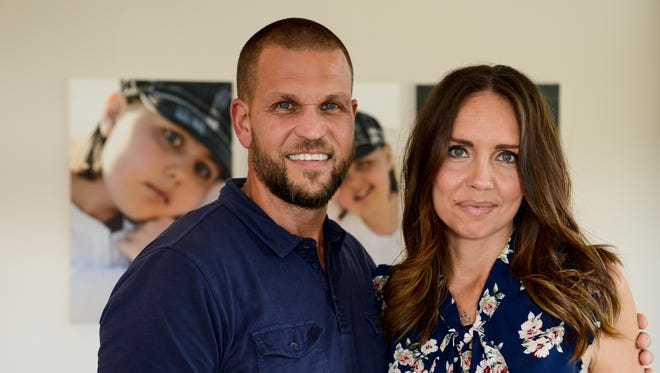
Together the Ives at present counsel other bereaved parents and doctors of pediatric cancer patients in a new model being pioneered at St. Jude Children's Research Hospital.
Through their leadership, the Ives are introducing a dissimilar arroyo to intendance, instructing medical professionals with accounts of real-life loss, and changing the way death and grieving are handled at the hospital.
"We become to show them nosotros survive and nosotros thrive," Tasha says. "We've plant a great purpose and healing."
And through it, "Sydney's legacy loves on."
A tumor's calamity of music notes
Sydney Ives was a strong-willed girl with short gilt hair, striking cobalt bluish eyes and total, pink lips.
She liked to work in the garden exterior the Ives' Rockford, Ill., home and assist her dad gear up up his truck. She loved cartoon and art, painting trees and flowers and sailboats. She sang southern gospel songs with her family at church.
And, she wanted to acquire to play music — a decision that inverse her life.
Seated in front of the piano at her very get-go lesson, her teacher demonstrated how the 9-year-one-time girl'due south petite fingers should be placed on the keys.
When Sydney tried, her correct paw vicious, causing a cataclysm of notes before dropping to her side. Information technology felt numb.
Sydney tried again, using her left hand to place each individual finger on her right.
Still she struggled.
That's when her mom knew something was incorrect.
Not just a klutz
"All of sudden all of these what I thought were separate, explainable symptoms snapped into place," Tasha says.
At a family wedding ceremony that previous weekend, Sydney kept dropping her dial loving cup. Tasha, a notorious klutz, thought she was rubbing off on her daughter.
Sydney often stepped out of her right flip-flop. Her parents figured the shoe had just stretched out, never imagining their daughter'southward toes may be losing feeling.
And the unremarkably chatty girl had become less so, lately. She was tired, more withdrawn. But Sydney didn't have a headache. There was no nausea. And so Tasha chalked it up to a recent tour of strep pharynx and a growth spurt.
But watching her daughter struggle to place her mitt on the pianoforte keys pushed Tasha to phone call the pediatrician.
Sydney went for a CT scan the next day.
Am I going to die?
Information technology was Memorial Mean solar day weekend, 2008.
The Ives were standing in a crowded outpatient CT waiting room, when the radiologist paged them.
"Your daughter has a very large brain tumor," he said, "and she needs to exist admitted right away."
Rockford had only one pediatric brain surgeon in the city, and he was out of boondocks for the vacation, so the Ives rushed Sydney to the University of Wisconsin-Madison where a biopsy revealed she had the very rare anaplastic astrocytoma.
It was inoperable.
Afterwards that night, Sydney asked her parents if she was going to die.
"We are all going to die one solar day," Tasha Ives gently told her girl. "I don't know if you will exit this world before Mommy does, and I don't know if you are going to die from cancer or not.
"Just God knows that."
What the Ives did know is they would try everything they could medically, and leave it in faith's hands.
Sydney's brilliant eyes looked into her mother's with resolve.
"OK," she said. "I'm in."
A strange land where doctors talk of horrible things
A couple weeks later, the Ives flew to Memphis to check into St. Jude.
Walking into the hospital, the four of them clustered tightly together, they felt lost and frightened. They didn't know where to put their luggage. Didn't know where they would be sleeping. At that place was no guide for what was to come.
The kickoff meeting with the oncologist was hard.
"I wanted to wring his neck," Dean says. "It's belatedly, we're tired, my daughter'south ill and we're in this foreign country.
"I am trying to exist the man of my family, and he's telling usa all these horrible things."
Simply at St. Jude, the children ran around "as if someone forgot to tell the kids they're sick," Tasha says. There was a girl with tubes in her nose. A boy without a leg. They looked happy.
And though the Ives struggled to procedure the prognosis, they saw their daughter— and their family — would be comfortable in that location, too.
"We establish out quickly that this place was a place of home," Dean says. "It was a safe place, and nosotros vicious in love with information technology."
Eating lunch with Joe Jonas
Sydney had 6 weeks of total-brain radiation, the maximum dosage immune, in hopes it would shrink the tumor and extend her quality of life.
But they knew it wouldn't relieve her.
"We, personally, didn't ever accept cure equally an choice," Tasha says, "other than a miracle."
They settled into a routine at St. Jude. Occupational, physical and oral communication therapy five days a week. Meetings with the oncologist. Chemo and radiation.
And new memories.
At the Target House, an apartment-mode residence where St. Jude families often stay, in that location was endless entertainment. Olympic gold medalist Shaun White had furnished a room with snowboards, skateboards and Xboxes. Golfer Tiger Woods had a library. Country star Brad Paisley had a music room.
At that place were pajama parties and movie nights. Sydney met the Dutchess of York and ate dejeuner next to her idol, Joe Jonas.
Later three months, the brain tumor shrunk some and the Ives went back to Illinois.
"We had to be home, and exist 'normal,'" Dean says.
Even in familiar surroundings, they found that home now felt like the foreign land.
Gone were the moms they bonded with in radiation waiting rooms and the dads who rode the double-decker to therapy appointments. They had no one who truly understood what they were feeling or going through.
And they would need that support even more in the grieving yet to come.
A unlike holiday at Halloween
Christmas came in October that next year.
Almost 18 months later her diagnosis, Sydney's quality of life declined. She experienced delirium, hallucinations. Tasha knew her daughter was nearing her final days.
"When life's normal I would never look at a ix-yr-old kid and retrieve this is the last time she is going to decorate her Christmas tree," Tasha says, her potent eyes turning contemplative. "I wanted those moments."
And so, in identify of Halloween decorations, they hung lights and ornaments. Friends and family unit arrived at the forepart door Christmas caroling. Sydney went outside in her wheelchair and Santa hat and sang with them.
And, on a autumn Illinois day, she unwrapped presents.
Sydney always loved fashion accessories, shiny bangle bracelets she paired with a cute hat and tiny handbag where she kept her chapstick, candy and glue. She needed 1 more piece of jewelry for her attire.
In a small box, at that place was a necklace. A silver heart.
Her mother had another, its matching pair, surrounded past a silver circle.
"We are ever connected," Tasha says.
'I just know it volition exist peaceful'
In one of their last out-of-the-firm excursions together, Tasha and Sydney stopped at a bulldoze-thru for a snack.
Sydney had a smiling on her face up, an I-know-something-you-don't-know look.
"What are you grinning virtually over there," Tasha asked.
"I am just ready to get abode whenever God wants me," Sydney responded.
"Do you call up that will exist presently?," her female parent said. "Does that scare you?"
"Oh, no," Sydney said. "I just know information technology volition be and so peaceful."
Later that night, every bit Tasha was tucking Sydney into her bed, she told her girl that she was her hero. "That'south and so cool I can be your mentor," Sydney responded in hostage.
"She was my mentor," Tasha says at present, reflecting on that moment and the years that led to information technology, "considering I learned something new from her every single day."
A purpose, helping bereaved parents
Tasha and Dean don't want that knowledge to exist lost.
And in their grieving, they have plant purpose — and a mode to heal.
Together, they now serve every bit bereaved parent mentors and educators at St. Jude.
There are many facets to their role, only perhaps most important is this: They counsel other families who lost their children and railroad train doctors and nurses how to communicate with bereaved parents — all in a new model pioneered at St. Jude.
"I remember there was this feeling of 'Nosotros're going to do something with this,'" Tasha says. "This was a very precious life and a light that has shown and nosotros have to proceed shining that light."
Equally founding members of the St. Jude Bereaved Parent Steering Council, the Ives help medical personnel delve into sensitive topics like discussing a diagnosis or treatment.
In workshops, they lead role-play scenarios where doctors practice delivering bad news to a family unit. On question-and-answer panels, they respond honestly near how information technology feels to lose a child and how they handle grief.
Earlier this year, they were office of St. Jude's outset ever Palliative Care Symposium with more than than 325 professionals from effectually the globe. Now, at St. Jude, all oncology fellows and staff nurses are now required to participate in 25 hours of training past parents of former patients.
"They accept loved it because it's never advisable to become back to a family that yous deliver bad news to and say, "By the way how did I do? Did I deliver that well? Fill out this survey and become back to me,' " Tasha Ives says.
"So nosotros become to be those stand up-in parents and tell them what's really helpful."
To the doctors they say, "Get down on our level, possibly be quiet, permit us cry. ... Let us procedure through our religion, let u.s. cope, because that may exist the only thing nosotros have to agree on to."
Day of Remembrance
This year, the Ives took their involvement one step further equally Dean chaired the annual Solar day of Remembrance.
On a 24-hour interval in mid-Oct, nearly 500 St. Jude parents and family members gathered to grieve together. They created collage boards filled with photos of soccer balls and beautiful hats and family vacations, all their children's favorite things.
Then they welcomed the doctors and nurses who had cared for their children in their darkest days.
Then many times, the staff is agape to cry. But there are e'er memories.
In their work, the Ives found 1 doctor who thought of a certain male child every fourth dimension he drove past Dunkin' Donuts. The kid had been a whiz with numbers and told the physician to invest in donut stock.
The doc never felt he could share that story with the parents. Just through the Bereaved Parents Council, the moms and dads are letting the doctors know it'south OK.
"Sometimes the doctors are brilliant," Dean Ives says. "But they don't know how to connect. ... Nosotros're breaking down this wall, and information technology's been the about healing thing."
Love you lot more than. Forever.
The Ives also continue to heal.
Not long ago, they moved to Ashland City. They were ready to motility on, to leave the place where they said goodbye to Sydney and start afresh.
Beingness in Tennessee brought them closer to family, and it allowed them to visit St. Jude more often.
"Nosotros do definitely have our moments of grief and difficult times," Tasha says, "but Sydney's legacy gives us determination to continue moving forward."
In their new home, Sydney'due south paintings hang on the wall. The recliner where she often slept sits next to their bedside. Her chocolate-brown Teddy deport, named Henry, lies on their pillows.
They didn't realize it when they moved, merely at present they know why they are hither.
When they stand on their balcony, they expect out over the water toward a beautiful tree-covered ridge.
It's called Sydney's Bluff.
Reach Jessica Bliss at 615-259-8253 and jbliss@tennessean.com or on Twitter @jlbliss.
Source: https://www.tennessean.com/story/news/health/2017/11/22/her-legacy-loves-on-daughters-cancer-death-inspires-new-grieving-program-parents-st-jude/667509001/

Post a Comment for "Will St Jude Be Selling the Bear Ornaments With Kmart Again in 2017"