what causes a chickens rear end to look dirty and like the feathers are gone
- Home
- Health
- Feather loss
Why is my chicken losing her feathers?
Of a sudden, your chicken run looks like someone unpacked a feather pillow and your flock looks like they've been freshly plucked.
What'southward going on, and what tin you do about it?
Please note: This folio is written as general information only. It is not intended as medical or veterinary advice and should not be taken as such.
If you're worried about your or your chickens' wellness, y'all should always run across your doctor or veterinarian.
Seeing your chickens with blank patches in previously beautiful plumage for the first time tin be very scary.
Most of the time, there's a perfectly elementary and easily rectified reason.
Some of the fourth dimension, it's not quite so elementary. Simply there's almost always a solution.
In this commodity, nosotros'll examine different ways chickens lose their feathers, the reasons behind their of a sudden scary await, whether you should be worried nearly it or it'southward but a normal part of the craven's life, and what you can exercise about it.
The article is divided into sections, then if yous want to observe one particular trouble just utilise these links.
Feathers lost all over; feather-picking; lesser has no feathers; no tail feathers; bald patches on back; plume loss on head and neck; no feathers on chest; why are my chicken's feathers all fluffed up? should y'all ever clip chickens' feathers?; do feathers abound back?
My chicken is losing feathers all over.
The most mutual reason for this is simple: chickens moult their feathers once a year, usually in the fall (fall). It'south nature'southward mode of taking out old feather and preparing for the cold by re-growing new, perfectly formed feathers.
I have a detailed article virtually moulting, here.
Nevertheless, if your flock has no feathers and it's not the autumn, you need to cheque other potential causes.
- Re-homed ex-battery (caged) hens often come with very poor feathering - a result of being locked in a confined infinite for long periods of fourth dimension with poor quality feed.
- Fowl pox tin can crusade extreme feather loss.
- Sometimes, farthermost stress can cause a moult. Chickens can detect many things stressful, but the nigh common causes of that astringent level of stress are predators and extreme heat.
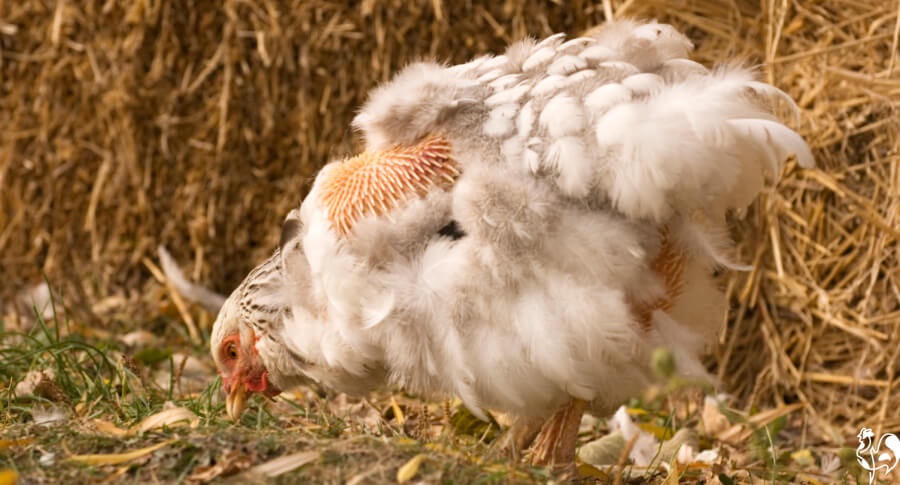 One of my normally beautifully feathered Light Sussex hens, partway through the autumn moult.
Solution.
- The almanac moult can look pretty horrendous, but it'southward nothing to worry virtually. You can help your flock by giving them some additional protein in their diet.
- Ex-bombardment hens needs specific care. The British Hen Welfare Trust has detailed information about this.
- Take activeness, earlier it happens, to protect your flock from whichever predators are common in your expanse. Find data here virtually foxes, birds of prey and the weasel family.
- Look after your chickens when it's hot. Something as simple equally a frozen treat can salvage them from dehydration.
My chickens seem to exist plucking their own feathers.
If you see your flock seeming to pull at their own feathers, don't immediately panic!
Like all birds, chickens naturally preen their feathers, using their beaks to pull dirt from their feather and, at the aforementioned fourth dimension, evenly distribute protective oils. It's a self-grooming deed, so goose egg to worry nearly.
Plume plucking is different - it's a behavioural problem, a sign there's something incorrect in the flock.
It's mostly considered to exist what'due south called a "re-directed behaviour"( ii ). In uncomplicated terms, this means that if chickens don't have annihilation else to peck at, specifically food, they'll start to peck at annihilation, and feathers are one of the things they'll turn to.
Research also proves that a lack of poly peptide has a direct link to plume-picking( 2 ).
And finally, this might merely be a case of aggression - chickens tin exist ruthless, particularly with new members of the flock.
Feather-plucking, as opposed to preening, can turn to full-blown cannibalism.
Then if you run across your flock actively picking out each other's feathers, you lot need to address it straight away.
Solution.
- Make sure your chickens accept bedding in the coop and, in the run, grass or similar to forage through.
- A properly balanced food should comprehend the flock's protein needs. Yet, if you come across feather-picking attempt adding some additional protein to the nutrition.
- My recipe for a Poultry Poly peptide Platter uses items y'all probably have in your store cupboard, then you can offering a loftier poly peptide treat straight away.
- If you lot have a dandy in the flock, you'll demand to isolate her until she learns to conduct! Discover out how in this commodity near how to put a craven into solitary confinement.
If yous buy a product through links on the rest of this page, I receive a small commission at no extra price to y'all. I just recommend products I accept purchased or would purchase myself and which I believe would benefit you. To learn more please see my disclosure policy .
My chicken has a red bottom and no feathers!
If a chicken is missing feathers around her vent and the vent is red and bloated, in that location are a couple of possibilities.
Firstly, check for cherry mite.
Secondly, check to see whether feather-pecking is going on. You lot'll need to but sit and lookout man your flock'due south behaviour. If you have a feather-picking bully, off she goes to isolation.
Finally, bank check for vent gleet.
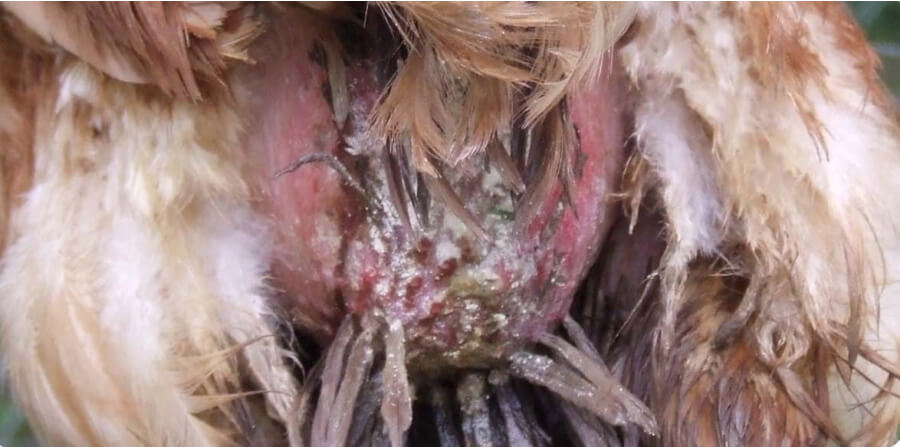 The tell-tale signs of vent gleet: no / dirty feathers and a red lesser. Image courtesy of the British Hen Welfare Trust.
Vent gleet is a fungal infection, often caused past mouldy feed or by an infection if the hen's lesser feathers have been pulled out (see this section).
Symptoms are no or dirty tail feathers, a red lesser, often bloated, a yellowish-white discharge and a disgusting odor...
Solution - vent gleet.
- Half make full a bowl of warm (not hot!) h2o and dissolve into it two tablespoons of unscented Epsom salts (again, if y'all haven't got some in your chickens' first aid kit, order some now!).
- Stand up the hen in information technology for at least x minutes.
- Remove her and pat dry with a towel, or utilise a hairdryer on a very low, warm setting.
- Apply some antifungal cream if you lot take it - it should be part of your chickens' first assistance kit!
- Repeat every two days until you run across an comeback. If the bottom remains red, you lot may demand to isolate the hen to prevent feather-picking. Applying some Blue Kote can help.
My chicken has no tail feathers!
A hen without her tail feathers is a sorry sight.
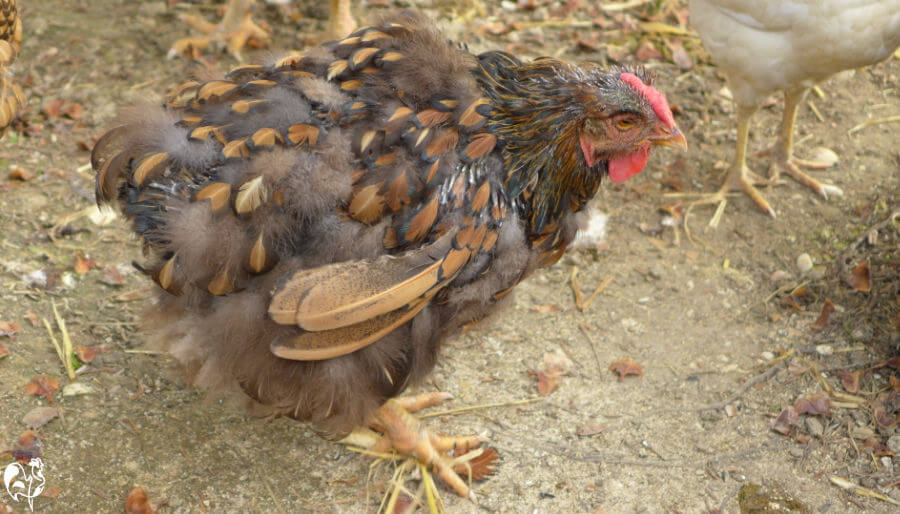 One of my Wyandotte hens looking very sorry for herself having lost her tail feathers.
Simply this is cipher to worry virtually - it'southward part of a normal moult. It's just possible, on the photo of one of my Wyandotte hens higher up, to run across the pin feathers starting to grow dorsum.
Here's a closer view...
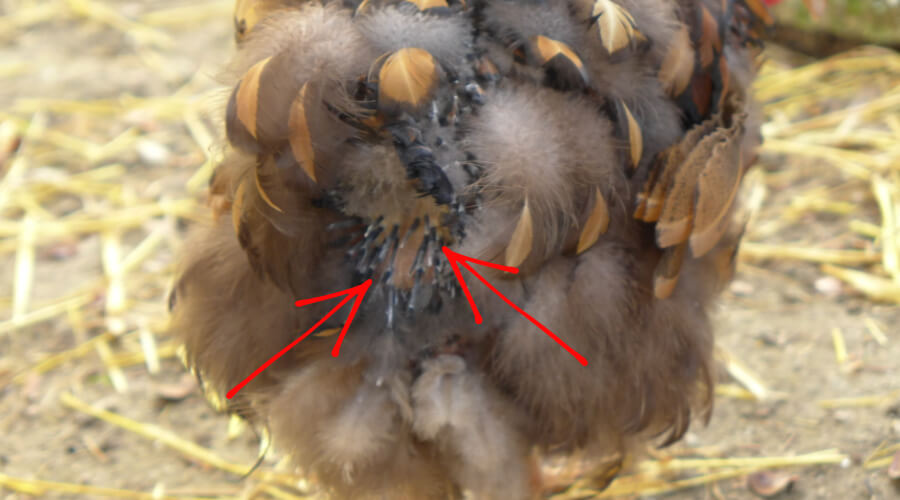 Pivot feathers are starting to abound the hen'south tail back again.
Solution.
- Every bit above, you can help a craven going through the moult in diverse ways, especially past offering some loftier protein foods.
My craven is losing feathers on her back!
If you lot accept a hen who'south all of a sudden missing feathers on her back, y'all tin can be pretty sure it'south due to a rooster (Great britain cockerel) paying her too much attention.
As a male mates with a hen, he volition cling onto the base of her neck and use his spurs to "tread" her dorsum.
The typical result is a loss of feathers on her dorsum.
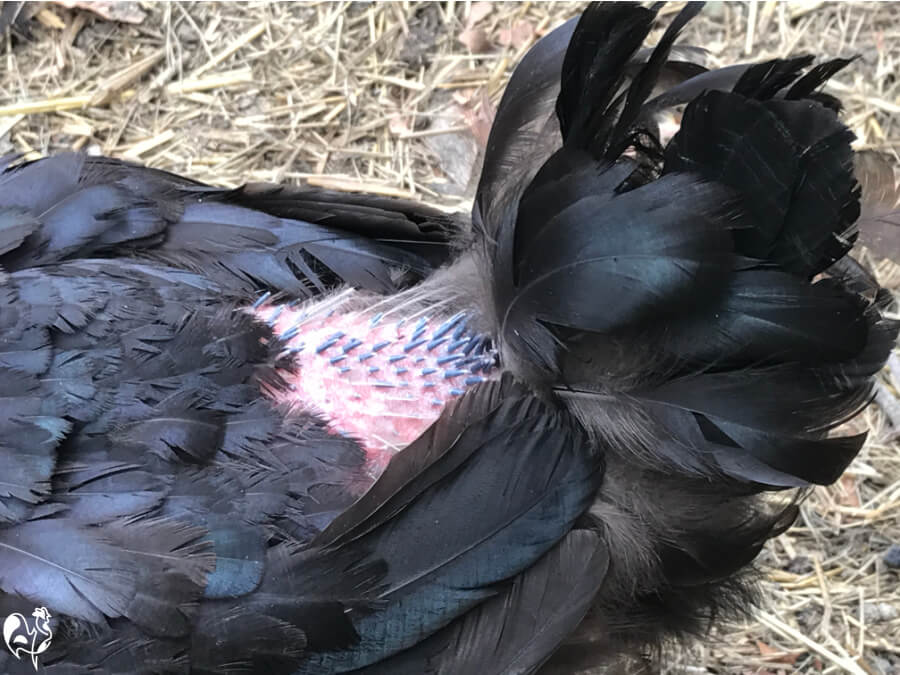 Typical pattern of feather loss on one of my Black Copper Marans hens, due to over-employ by a male.
Solution.
- Information technology'south sometimes necessary to isolate a hen, if she's existence heavily over-used, until her feathers take grown back.
- Of class, you lot could also isolate the male, who's the source of the trouble!
- "Hen saddles", as well known every bit "aprons", are pieces of textile you tin can adhere to your hen which help protect her back from the male's feet.
Chickens losing feathers on the neck and head.
There are two reasons for this...
Y'all may take a naked neck craven!
Equally the name implies, these chickens take no feathers on their neck, and you'll see no signs of the feather follicle from which the pivot feathers emerge.
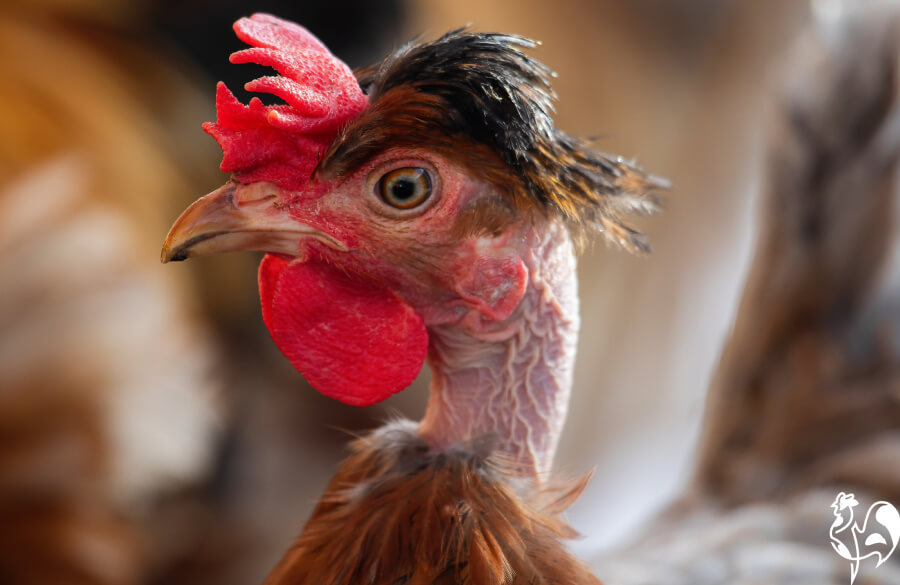 This is a naked neck chicken - at that place are no feathers on her neck.
The 2d reason is one time over again over-use by a male person chicken.
The rooster (UK cockerel) frequently holds onto the hen'south neck feathers are he mates with her, and that can result in alopecia on the head and neck.
Solution.
- Be careful if the feather-pulling results in exposing blood-red skin. Crimson attracts pecking, so other hens will be compelled to pick at information technology.
- Use some Blue Kote to the skin. It will stain purple, then hiding the angry red color, and allow the feathers to grow dorsum without existence pecked at.
My craven has no feathers on her chest.
Information technology tin look scary, simply this is normal for a hen who is "broody" - who wants to hatch eggs.
When we use an electric incubator to hatch, we need to make sure both the rut and moisture levels are kept just right.
A hen losing breast feathers is just nature'south way of doing this. With no feathers betwixt her and the eggs, the chest, which she will place directly over the eggs, provides the ideal levels of both estrus and moisture equally she incubates her hatching eggs.
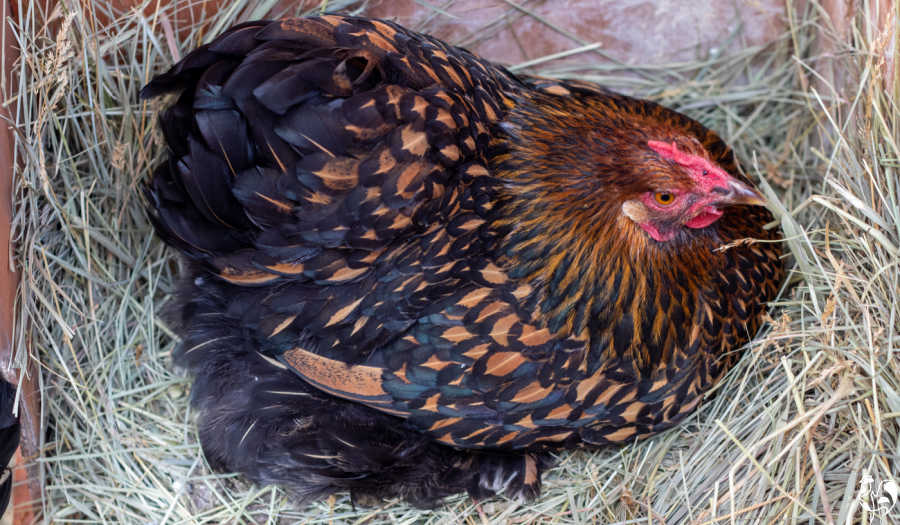 A broody hen will lose her chest feathers and so she tin properly incubate her eggs.
Solution.
- If your hen has "gone broody" and you don't want her to, you lot'll need to isolate her.
- Other than that, there's no solution needed - this is perfectly normal behaviour. Her feathers volition grow back one time the chicks have hatched.
My chickens are puffing their feathers up. Is that normal?
It depends.
It can be, and usually is, completely normal.
Chickens fluff their feathers upward to keep themselves warm in cold atmospheric condition. In particular, they'll fluff up enough to encompass their feet, which protects them from frostbite.
And a mother hen will fluff up to keep her young chicks warm.
But - if you see a chicken puffed upward and inactive or unresponsive, and looking generally unwell, it may exist a sign of illness.
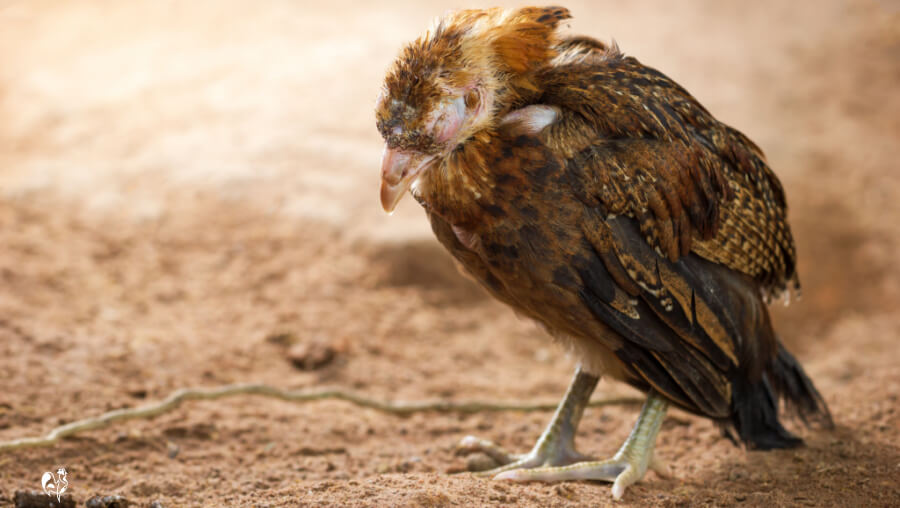 This craven is puffed upwards considering she's ill. It's not hard to tell.
Solution.
- If your chickens look otherwise healthy, there'southward nothing to exercise. It's normal behaviour.
- If they're looking unwell, particularly if they are hunched and look drowsy, in that location may be a health issue.
Should you ever clip chickens' feathers?
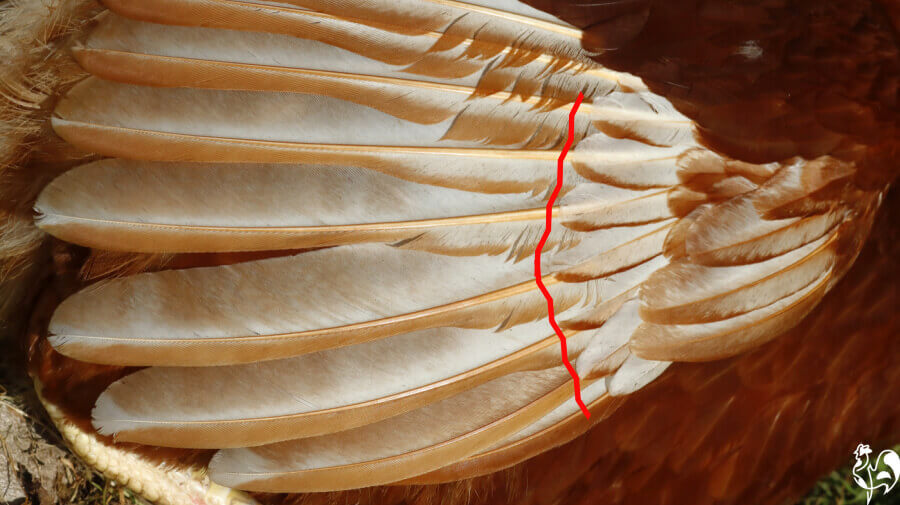
This is a personal affair.
Chickens cannot fly for any distance, but they can certainly do a baroque hopping, jumping, flight motion which can see them getting over a six or seven pes fence.
If that happens and your flock is flying into danger - into the mouths of your neighbour's dog, for instance, and then clipping does go an option.
Solution.
Clipping chickens' wings does non hurt them, is not painful, is not cruel, and tin can be done with the minimum of fuss if it's washed properly.
And it keeps them from flying into impairment's manner.
I have an article nearly how to do it safely and quickly, putting your chickens at ease and keeping them prophylactic. It includes a video of me clipping 1 of my Cerise Star'southward wings after she had escaped, only to observe herself between the jaws of a passing dog.
Come across how to clip a chicken's wing feathers safely, here.
Do chicken feathers grow dorsum?
Aye.
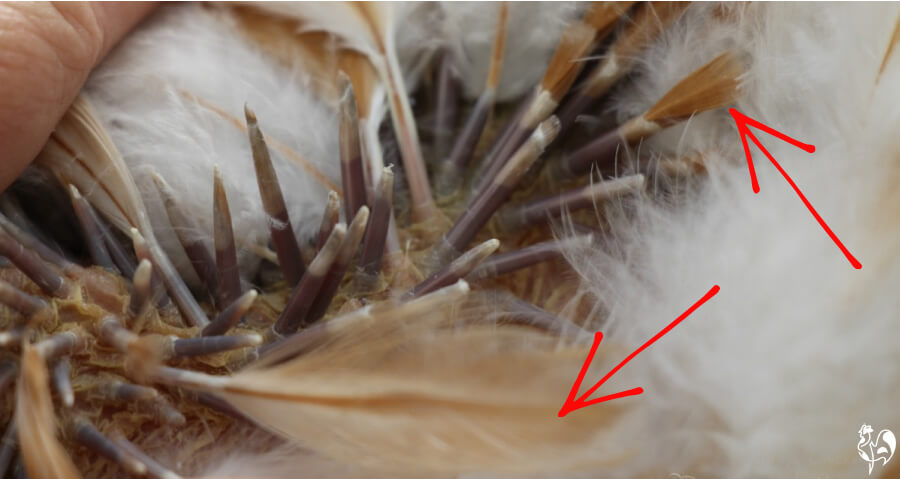
You'll meet the small, stumpy quills beginning to have shape to supersede the lost feathers. Here, one of my Wyandottes is growing her feathers dorsum later on a moult.
You can see the feathers coming from the top of the quill (where the arrows are).
Solution.
- If you lot've clipped your chickens' wings to keep them safe, you lot'll need to do it again after they have moulted considering the wing feathers will take grown back.
- Pin feathers are very sensitive and can cause hurting. If you see pivot feathers appearing, exist very careful how y'all handle your chicken - don't handle her at all if you don't have to.
You may likewise find these pages useful.
Sources.
A lot of "facts" you'll find on the internet are oft people's private views, based on inaccurate data repeated from poor quality sources.
The information I provide in this article and others is based not just on my ain experience, but on evidenced facts from scientific, peer-reviewed enquiry and books from highly respected and experienced poultry keepers such as Gail Damerow.
Some of the trusted sources I have used in this article are these.
1. The British Hen Welfare Trust is an excellent source of information and support for anyone adopting ex-battery hens.
2. Sedlačková, 1000:Feather Pecking in Laying Hens: Environmental and Endogenous Factors. Pub. Institute of Beast Biochemistry and Genetics, 2004.

Popular articles

ecertified in chicken welfare and behaviour!
Source: https://www.raising-happy-chickens.com/chicken-losing-feathers.html

Post a Comment for "what causes a chickens rear end to look dirty and like the feathers are gone"